

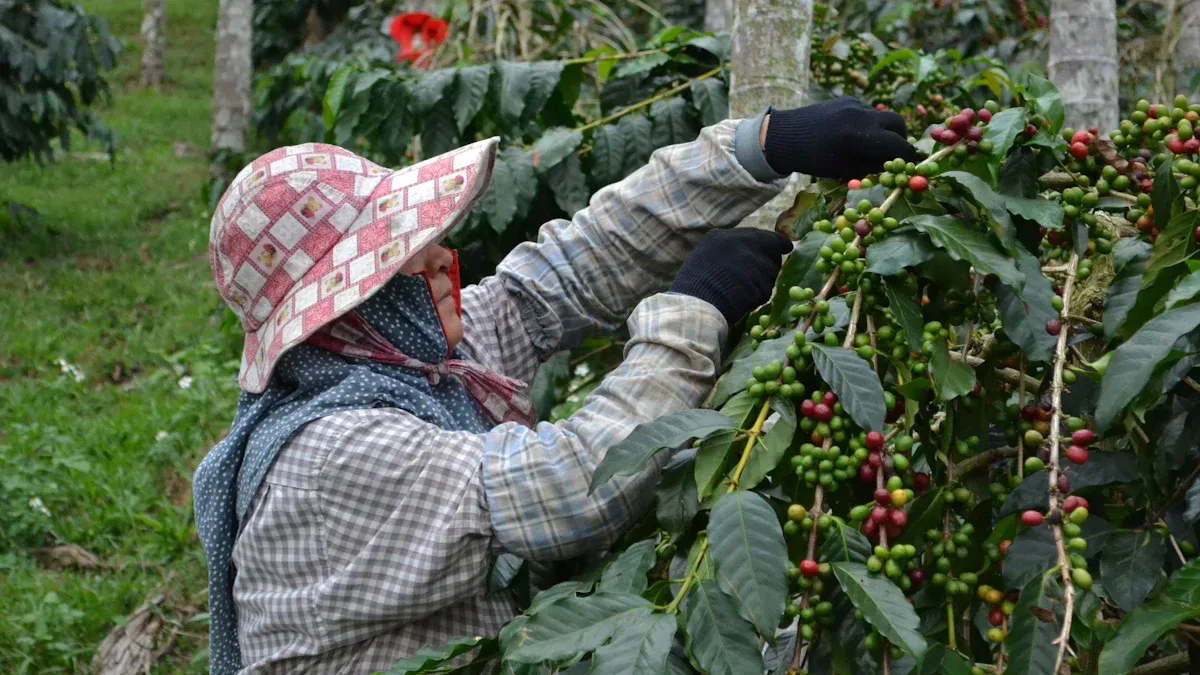
Coffee’s origins trace back to Ethiopia, where a goat herder named Kaldi discovered the energizing effects of coffee beans. This legend symbolizes coffee’s deep connection to cultural and spiritual practices. By the 15th century, Yemen became the first documented region to cultivate coffee. There, the beverage integrated into social and religious life, marking the beginning of coffee’s journey out of Ethiopia. As you explore the rich history of coffee, you will uncover how it transformed societies across the globe.
Key Takeaways
Coffee originated in Ethiopia, where a goat herder named Kaldi discovered its energizing effects, leading to its cultural significance.
The coffee ceremony in Ethiopia symbolizes hospitality and community, highlighting coffee’s role in social bonding.
Coffee spread to the Arabian Peninsula in the 15th century, where coffee houses became centers for social interaction and cultural exchange.
In Europe, coffee transformed from a controversial drink to a beloved staple, influencing social gatherings and intellectual discussions.
Modern coffee cultivation focuses on sustainability and technology, ensuring quality and environmental health while supporting farmers’ livelihoods.
Origins of Coffee: The Legend of Kaldi
Early Cultivation Practices
The story of Kaldi, the goat herder, reveals the fascinating beginnings of coffee. According to legend, Kaldi noticed his goats becoming unusually energetic after eating the berries from a certain plant. This discovery led to the first known use of coffee beans. The Coffea plant, native to the Aromia region of Ethiopia, became the foundation for coffee cultivation.
In Ethiopia, farmers developed various cultivation systems that shaped how coffee grew. Here’s a look at these systems:
Cultivation System | Description | Contribution to Production |
|---|---|---|
Forest Coffee System | Coffee trees grow wild under forest canopies with minimal human interference. | ~10% |
Semi-forest Coffee System | Wild coffee trees are maintained with selective thinning of the canopy. | ~35% |
Garden Coffee System | Smallholder farmers intercropping coffee with other crops near their homes. | ~50% |
Plantation Coffee System | Improved varieties cultivated on managed estates with structured practices. | ~5% |
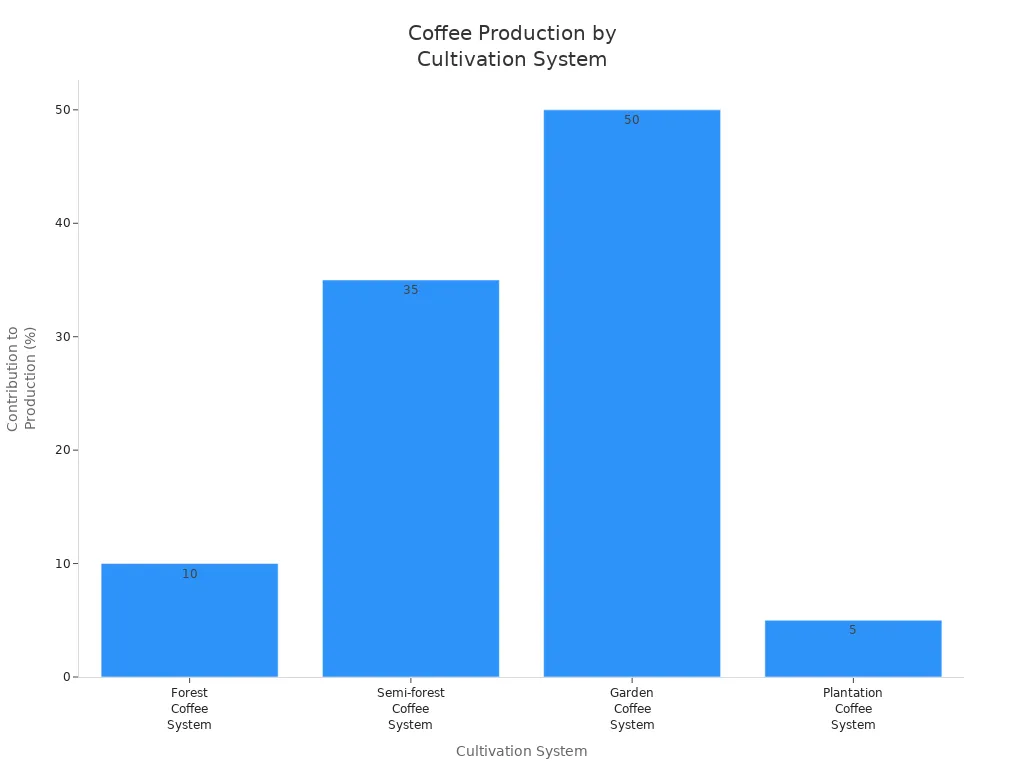
These systems highlight the diversity in early coffee cultivation practices. Farmers adapted their methods based on local conditions and resources.
Cultural Significance in Ethiopia
Coffee holds a special place in Ethiopian culture. The traditional coffee ceremony symbolizes hospitality and community. During this ceremony, people wash and roast green coffee beans, grind them, and brew them in a special pot called a jebena. They serve the coffee in small cups, often in three rounds: First Round, Second Round, and Third Round. Each round deepens connections among participants.
The coffee ceremony is more than just a drink; it fosters social bonds. Friends and family gather to share stories and strengthen relationships. In Ethiopia, coffee is not only an important agricultural export but also a vital part of daily life. It provides livelihoods for millions, supporting local economies and sustaining community ties.
Through the legend of Kaldi and the rich cultural practices surrounding coffee, you can see how coffee origins shaped not just agriculture but also social structures in Ethiopia.
The History of Coffee in the Arabian Peninsula
Coffee, known as qahwa in Arabic, first brewed in Yemen by Sufi saints in the 15th century. This marked the beginning of coffee’s journey in the Arabian Peninsula. The Ottomans invaded Yemen in the 16th century, helping to popularize coffee throughout the region. Historical records indicate that coffee’s presence in the area dates back to the 9th century.
Coffee Houses and Culture
As coffee spread, coffee houses emerged as vital centers of social life. These establishments became central to community interactions. You could find people gathering to enjoy coffee while engaging in various activities. Here are some key aspects of coffee houses in the Arabian Peninsula:
Social Interaction: Coffee houses served as venues for friends and strangers to meet, fostering connections.
Cultural Exchange: They hosted literature gatherings, poetry readings, and live music, enhancing the region’s cultural practices.
Storytelling: These spaces thrived on storytelling, with performances reflecting the social and religious landscape of the time.
Coffee houses became known as “Schools of the Wise,” where people exchanged ideas and engaged in intellectual discourse. This cultural significance helped shape the coffee culture you see today.
Trade and Economic Impact
The establishment of coffee houses along trade routes facilitated the spread of coffee and served as hubs for commercial activity. During the late 16th century, Yemen developed a robust coffee economy, particularly in its western highlands. Coffee became a key export, with caravan routes connecting to Red Sea ports like Mocha. This port linked Yemen to major trade cities such as Jeddah and Cairo.
By the 17th century, the demand for Yemeni coffee surged, surpassing many global spice trade commodities. Yemen became the leading coffee producer and exporter, with Mocha becoming synonymous with coffee. The prime location of coffee on the Arabian Peninsula allowed it to spread along trade routes to Northern Africa and beyond.
The thriving port of Mokha in the 1600s contributed significantly to coffee’s global recognition. Coffee houses not only served coffee but also fostered community and dialogue among diverse groups. This blend of commerce and culture played a crucial role in shaping the history of coffee in the Arabian Peninsula.
Coffee’s Arrival in Europe
Coffee made its way to Europe in the 16th century through trade routes established by the Ottoman Empire. The first coffeehouse opened in Venice in 1645, marking a significant moment in the spread of coffee culture across the continent. These coffeehouses quickly became centers for social interaction. You would find intellectuals and merchants gathering to discuss ideas and conduct business transactions.
Initially, European societies had mixed reactions to coffee. Some monarchs expressed concern, viewing coffee as a potential catalyst for political unrest. They worried that coffeehouses could become hubs for radical discussions. This apprehension led to attempts to prohibit coffee consumption and even the closure of some coffeehouses. However, these efforts did not last long. The allure of coffee proved too strong, and its popularity continued to grow.
European Reception
As coffee gained traction, it transformed from a controversial beverage to a beloved staple. The drink became associated with social gatherings and intellectual discourse. During the Enlightenment, coffeehouses served as “penny universities.” Here, philosophers, writers, and artists gathered to exchange ideas. This environment significantly influenced social and intellectual discourse in the 17th and 18th centuries.
You might be surprised to learn that coffeehouses played a crucial role in shaping public opinion. They provided a space for people to engage in discussions about politics, philosophy, and art. This vibrant atmosphere helped solidify coffee’s place in European culture.
The Rise of Coffee Culture
The rise of coffee culture in European cities can be attributed to several factors:
The growth of specialty coffee consumption is evident with over 17,000 specialty coffee shops in Europe as of 2023, particularly in Germany and France.
Urbanization trends have led to the rise of café chains, with the UK boasting over 9,500 branded coffee shops in 2024.
A shift towards premiumization is indicated by a 4.3 billion increase in household spending on premium food and beverages, with coffee being a significant contributor.
The concept of high-quality coffee shops emerged alongside new sourcing and roasting methods. Influenced by micro-roasters in the U.S. during the 1990s, this trend has led to a focus on bean selection, roasting processes, and barista training. As a result, you can now find a diverse range of coffee offerings in major cities.
Independent cafés are also gaining popularity. They provide unique local experiences and compete with major chains through small-batch roasting and curated drink menus. Additionally, there is a growing interest in sustainability and product origin. Consumers increasingly prefer ethically sourced coffee, reflecting a broader trend towards conscious consumption.
Through these developments, coffee culture has become an integral part of European life. The journey of coffee from its origins in Ethiopia to its establishment in Europe showcases its remarkable evolution and enduring appeal.
Coffee Cultivation in the Americas
Introduction to the New World
In the early 18th century, coffee made its way to the Americas thanks to Gabriel de Clieu. Born in Dieppe, France, he learned about a failed attempt by Michel Isambert to introduce coffee to the New World. Determined to succeed, he covertly acquired coffee seedlings and embarked on a challenging journey to Martinique. During his voyage, he faced numerous obstacles, including a pirate attack and a tropical storm. Despite these challenges, he successfully planted the coffee in Martinique. This marked the beginning of coffee cultivation in the Americas, leading to the establishment of plantations across Latin America.
Economic Impact of Plantations
The introduction of coffee transformed economies in the Americas. Coffee plantations became significant contributors to local and national economies. Here are some key points about the economic impact of coffee plantations:
The coffee industry in the U.S. had a total economic impact of $343.2 billion in 2022, marking a 52.4% increase since 2015.
It supports over 2.2 million jobs in the U.S., generating more than $100 billion in wages annually.
For every $1 of coffee imported, approximately $43 in value is created domestically.
Daily consumer spending on coffee products exceeds $300 million, totaling nearly $110 billion per year.
In Latin America, coffee plays a crucial role in national exports and GDP. The contribution varies across countries, with many farmers relying on coffee for their livelihoods.
However, coffee plantations also face challenges. Labor practices on these plantations often raise concerns. A table below summarizes some of the issues:
Evidence Type | Description |
|---|---|
Labor Violations | Minimum wage violations are common, with workers often paid less frequently than required by law. |
Child Labor | High prevalence of child labor, with children as young as five working on plantations, often alongside their parents. |
Economic Impact | Coffee production provides livelihoods for over 26 million people, but market volatility can lead to poverty among farmers. |
Despite these challenges, coffee cultivation remains a vital part of the economy in the Americas. The journey of coffee from its introduction by Gabriel de Clieu to its establishment as a major agricultural product illustrates its profound impact on society and the economy.
Modern Coffee Cultivation Practices
Technological Advancements
Modern coffee cultivation has embraced various technological advancements that enhance efficiency and quality. You will find that automation technologies play a crucial role in improving production. For instance, mechanical dryers streamline the drying process, reducing risks of fermentation and mold growth. Additionally, advanced fermentation control systems ensure that you achieve consistent flavor profiles in your coffee.
Here are some key innovations shaping coffee cultivation today:
Crop Monitoring: High-tech sensors and IoT devices provide real-time data on soil conditions.
Automation: This addresses labor shortages and reduces manual harvesting costs.
QR Code Tagging: Blockchain systems enhance transparency in the coffee supply chain, building consumer trust.
Innovation Type | Description |
|---|---|
Drone Monitoring | Provides real-time insights into crop health, enabling early detection of pest infestations. |
Soil Sensors | Analyzes soil health and moisture levels for precise irrigation strategies. |
Smart Irrigation Systems | Optimizes water usage through AI, ensuring crops receive the right amount of water. |
Sustainability in Coffee Farming
Sustainability has become a vital focus in modern coffee farming. You may notice that many farmers adopt practices that promote environmental health and social responsibility. Here are some widely adopted sustainability practices:
Practice | Benefits |
|---|---|
Shade-Grown Coffee | Enhances biodiversity and improves soil health. |
Organic Farming | Reduces chemical runoff and regenerates soil. |
Water Conservation Techniques | Promotes responsible water use through rainwater harvesting and drip irrigation. |
Ethical certifications like Fair Trade and Rainforest Alliance also impact coffee cultivation. These certifications encourage farmers to use sustainable practices while ensuring fair wages and safe working conditions. However, challenges remain, as some producers report little improvement in income or working conditions despite certification.
As you explore modern coffee cultivation, you will see how technology and sustainability work together to shape the future of coffee farming.
The journey of coffee cultivation spans centuries and continents. You learned about its origins in Ethiopia, where it began as a simple berry. The spread to the Arabian Peninsula marked a significant cultural shift, leading to the establishment of coffeehouses as social hubs. In Europe, coffee transformed from a controversial drink to a beloved staple, influencing social interactions and intellectual discourse.
Today, coffee remains a vital economic driver, with millions relying on it for their livelihoods. However, challenges like climate change threaten its future. Sustainable practices are essential to ensure that coffee can continue to thrive. Initiatives like the Sustainable Coffee Challenge aim to make coffee the world’s first truly sustainable agricultural product. As you enjoy your next cup, remember the rich history and the ongoing efforts to secure a sustainable future for coffee.
