

Freshly ground beans can make a noticeable difference during rushed weekday mornings, relaxed weekend pour-over sessions, and travel days away from your usual coffee station. You’ll find compact blade mills, adjustable burr machines, and manual options here, so you can match the grinder to your brewing method, counter space, and tolerance for hands-on work. The right choice helps you control grind size without adding a frustrating step to your routine. You’ll also see honest trade-offs, especially around consistency, cleanup, capacity, and portability.
The Shortlist At A Glance

Wancle Electric Coffee Grinder, Quiet Spice Grinder, One Touch Coffee Mill

Lonkion Burr Coffee Grinder Electric, 28 Grind Settings, Stainless Steel

CEVING 60g Large Capacity Manual Coffee Grinder, Black, 40 External Settings

Rsoilch Manual Coffee Grinder, Ceramic Burr, 5 Adjustable Settings

KIDISLE Conical Burr Coffee Grinder, 35 Settings, 2–12 Cup Selector

Dalle Small Coffee Grinder, 200W Stainless Steel Spice Grinder
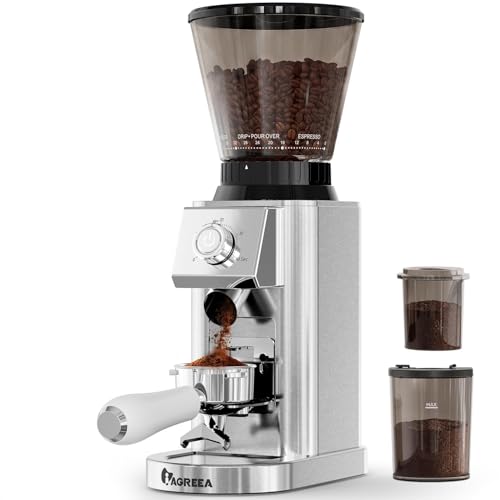
IAGREEA Conical Burr Coffee Grinder, 48 Grind Settings, 450RPM
SHARDOR Burr Coffee Bean Grinder, 32 Settings, 40-Second Timer
More Details On Our Top Picks
One-touch control keeps the Wancle focused on uncomplicated morning use. You press the control to grind and release it to stop, so you can adjust the texture by watching the beans through the transparent lid. That hands-on timing suits drip coffee and other everyday brews, though it asks you to stay nearby rather than select an automatic dose.
The stainless steel blade and body should feel at home beside other stainless kitchen tools, while the included cleaning brush gives you a practical way to clear lingering grounds. You may find the 60g capacity useful for several mugs, but a blade grinder generally offers less uniform particle size than the burr choices below. Its compact, familiar format benefits you most in a busy kitchen that also needs occasional spice grinding.
Strong Points
- One-button operation makes short grinding sessions easy to start and stop.
- The transparent lid lets you watch the texture instead of relying on a preset.
- A 60g bean capacity suits a small group without requiring constant refills.
- The cleaning brush supports simpler routine maintenance after coffee or spices.
- Stainless steel construction should tolerate regular kitchen handling better than a delicate plastic-only shell.
Things To Consider
- Blade grinding can produce a less even mix than the Lonkion Burr Coffee Grinder Electric.
- Manual timing means you’ll need to repeat your preferred press duration for similar results.
- Spice use may leave aromas behind, so separate cleaning matters before returning to coffee.
Key Specs
Who It Suits Best
You’ll appreciate this choice most for quick coffee, occasional spices, and simple one-button control in a compact home kitchen.
Consider Something Else When
Choose the SHARDOR Burr Coffee Bean Grinder instead when you want timed burr grinding and a removable hopper for a more structured daily routine.
Grind-size flexibility gives the Lonkion a more adaptable role than the Wancle blade mill. Its flat metal burr, a pair of grinding surfaces that crush beans rather than chop them, is designed for a more even texture across settings. You can move between fine espresso-style grounds and coarser French press grounds, although dialing in a new setting still takes a little patience.
The 2-to-12-cup selector brings useful structure to a shared household routine. Auto-stop can keep you from standing over the machine while breakfast comes together, and the stainless steel finish should wipe clean without much fuss. In most kitchens, this is a sensible step up for you when brew variety matters more than spice-grinding versatility.
What We Like
- Twenty-eight grind positions give you more control than a simple blade grinder.
- The flat metal burr design is suited to repeatable coffee preparation across several brew styles.
- A 2-to-12-cup selector helps match the batch to a single mug or a larger pot.
- Automatic stopping reduces one more task during a crowded morning.
Trade Offs
- More adjustment points can make the first setup feel less immediate than the Wancle’s press-and-watch method.
- Ground coffee can collect around burr areas, so regular brushing remains part of ownership.
- The electric format needs a fixed counter location and outlet access, unlike the portable CEVING grinder.
At A Glance
Made For
This grinder fits home coffee drinkers who alternate between espresso-style, drip, and French press preparation.
Not Your Match When
Reach for the Dalle Small Coffee Grinder instead when you need a compact electric tool for both coffee and a wider range of seasonings.
For camping trips, hotel rooms, and pour-over kits, the CEVING trades electrical convenience for control and portability. Its stainless steel conical burr uses angled grinding surfaces to work through beans with a hand crank, while 40 external settings let you change the grind without taking the body apart. The large 60g chamber is the practical distinction here, especially for several travel cups or a French press.
You’ll need to supply the effort, and that matters during a rushed morning or a large family breakfast. Compared with the five-setting Rsoilch Manual Coffee Grinder, the CEVING offers much finer adjustment, but its larger capacity may add bulk to a small travel kit. Depending on your hand strength and batch size, the design makes the most sense for people who value independence from outlets.
Highlights
- The 60g capacity can cover a larger brew session in one grinding cycle.
- Forty external adjustments give you a clear way to tune grind size while brewing outdoors.
- A stainless steel conical burr suits pour-over, French press, and cold brew preparation.
- Manual operation avoids cords, outlet hunting, and dependence on a kitchen counter.
- The portable format works well inside a camping or travel coffee kit.
Room For Improvement
- Hand grinding a full 60g load takes more physical effort than using Lonkion Burr Coffee Grinder Electric.
- More moving parts around the crank and adjustment ring call for careful brushing and storage.
Technical Sheet
Right Fit For
You’ll get the most from this grinder during camping, travel, pour-over brewing, or larger manual batches.
Look Elsewhere When
Choose IAGREEA Conical Burr Coffee Grinder instead when your priority is fast countertop preparation with many grind adjustments and a timed electric process.
Five grind settings keep the Rsoilch easy to understand, which can be helpful for a first manual grinder. The ceramic burr, a hard grinding surface designed to crush beans, supports adjustments for espresso and French press, while the stainless steel bottle gives the tool a durable-feeling travel profile. You won’t get the dialing range of the CEVING, but you may prefer this shorter learning curve.
Its hand crank makes it suitable for camping, travel, and kitchens without a convenient outlet near the coffee setup. The compact body stores neatly in a drawer or travel bag, although manual grinding still takes time for multiple cups. The honest read is that this is a straightforward choice for modest batches rather than a detailed espresso-tuning instrument.
Upsides
- Ceramic burr grinding gives you a more deliberate alternative to blade chopping.
- Five settings keep the controls approachable for basic espresso and French press use.
- The stainless steel bottle is practical for travel and repeated handling.
Points To Note
- Five positions offer less fine control than the 28-setting Lonkion or 40-setting CEVING.
- Hand grinding can feel slow for a full household pot.
- Cleaning around a ceramic burr requires care, especially after fine grounds collect in the mechanism.
Quick Facts
Who Will Love This
This grinder suits beginners, occasional campers, and solo coffee drinkers who want a small manual tool with uncomplicated adjustment.
A Better Fit Elsewhere
CEVING 60g Large Capacity Manual Coffee Grinder suits you more when you need larger batches and a wider external adjustment range.
Thirty-five settings give the KIDISLE room to cover espresso-style, drip, and French press routines without forcing you into a narrow brewing lane. Its conical burr uses angled surfaces to crush beans, and the dial control keeps grind selection separate from the 2-to-12-cup amount selector. Compared with Lonkion Burr Coffee Grinder Electric, you gain seven more positions, which can help you make smaller adjustments as your coffee preferences change.
The transparent hopper and grounds container let you monitor both the beans and the collected coffee, a small convenience during busy mornings. An anti-static design is intended to reduce cling and scattered grounds, though you’ll still want to brush the grinding path regularly. In a shared kitchen, this combination of capacity control and broad adjustment makes the KIDISLE a sensible fit for several coffee habits under one roof.
Standout Traits
- Thirty-five grind settings give you more tuning space than the Lonkion’s 28 positions.
- The 2-to-12-cup selector helps you prepare a single serving or a larger household batch.
- Transparent storage areas make remaining beans and grounds easy to monitor.
- The conical burr format supports multiple brewing methods with a more controlled grind than a blade system.
- Anti-static construction may help keep loose grounds from spreading around a small coffee station.
Minor Gripes
- The broader control set takes longer to dial in than the five-setting Rsoilch.
- Transparent parts show residue, so frequent wiping may matter more to you visually.
- Fine grounds can still remain around burr components and require routine cleaning.
Feature Snapshot
Best Suited To
You’ll find the KIDISLE most useful in a household where several people use different brewing methods and batch sizes.
Swap It Out When
Wancle Electric Coffee Grinder, Quiet Spice Grinder suits you better for quick, manual-timed grinding and occasional spice preparation.
The Dalle makes more sense as a compact food-preparation tool that also handles coffee than as a precision-focused brew grinder. Its stainless steel chamber and blade system suit beans, seasonings, pepper, herbs, nuts, seeds, and grains, so you can keep one small appliance available for several kitchen jobs. The stated 200W power and 28,000 RPM speed point toward fast short sessions, though speed alone doesn’t create the even grind associated with burr machines.
At 3.54 by 3.54 by 5.91 inches, the body should fit a crowded apartment counter or a cabinet with limited vertical room. You’ll need to manage grind duration yourself, and switching between strong spices and coffee calls for careful cleaning to avoid flavor carryover. Compared with Wancle Electric Coffee Grinder, Quiet Spice Grinder, the Dalle offers more explicit multi-food versatility, while both retain the basic blade-grinder trade-off.
Bright Spots
- The 200W motor and specified 28,000 RPM speed suit quick grinding sessions.
- Stainless steel construction is practical for a tool that handles food ingredients.
- The small footprint helps you preserve counter space in an apartment kitchen.
- Multi-purpose use lets you process coffee, spices, herbs, seeds, grains, and nuts with one appliance.
Small Caveats
- Blade grinding gives you less particle-size control than the burr-based KIDISLE or IAGREEA.
- Manual timing makes repeatable coffee texture more dependent on your technique.
- Strong ingredients may leave aroma in the chamber, so cleaning between uses is especially important.
Feature Rundown
Whose Shelf It Belongs On
This item suits you when counter space is tight and you want one small electric grinder for coffee plus varied cooking ingredients.
Another Choice May Suit
Choose SHARDOR Burr Coffee Bean Grinder instead when your main goal is repeatable coffee texture, timed operation, and easier separation from spice use.
Forty-eight grind settings put the IAGREEA at the adjustment-heavy end of this group. The conical burr covers ultra-fine through extra-coarse territory, while the 450 RPM low-speed motor is intended to limit static and heat during grinding. You may value that slower approach during careful pour-over or cold brew preparation, although a larger adjustment range can take longer to learn.
A precision timer adds repeatability to your daily dose, and the metallic silver finish gives the grinder a dedicated coffee-station feel. Compared with the KIDISLE, the IAGREEA offers 13 additional grind positions and a stated low-speed motor, but the listing provides fewer details about cup selection. For a home barista who changes recipes often, that trade-off may be worthwhile.
Reasons To Buy
- Forty-eight settings give you fine control across espresso, drip, French press, and cold brew.
- The 450 RPM low-speed design is intended to reduce static and heat during operation.
- A precision timer supports more repeatable preparation from one session to the next.
- The conical burr system suits a dedicated coffee routine better than a multi-purpose blade mill.
- The metallic silver finish works naturally in a permanent home coffee station.
Areas To Watch
- Forty-eight settings can feel excessive for you when your routine stays with one brew method.
- The slower 450 RPM approach may not suit mornings where speed matters most.
- Fine burr components need regular brushing to keep old grounds from affecting later batches.
Details At A Glance
Built With In Mind
You’ll benefit most from this grinder as an experienced home coffee maker who changes grind sizes and values timed, low-speed control.
Where A Sibling Pick Shines
Lonkion Burr Coffee Grinder Electric is a better fit for you when 28 settings and a 2-to-12-cup selector provide enough control with a simpler daily workflow.
Small counters often leave little room for a full coffee setup, and SHARDOR addresses that constraint with a compact burr grinder body. Its flat burr system is intended for drip, pour-over, French press, cold brew, moka pot, and espresso-style drinks, while 32 settings give you useful room to adjust texture. That range sits between Lonkion and KIDISLE, making it approachable without feeling overly narrow.
The 40-second timer lets you control the grinding period for a single cup or a larger preparation, and the removable hopper makes bean changes and cleaning more manageable. A chamber-cleaning button adds a dedicated way to clear residual grounds, though you’ll still need normal brushing and wiping around the collection areas. For an apartment, office corner, or compact home coffee station, this is a well-balanced format with few unnecessary extras.
Plus Points
- Thirty-two settings cover a broad set of everyday brewing methods.
- The 40-second timer gives you direct control over small-batch grinding.
- A removable hopper simplifies bean changes and routine cleaning.
- The chamber-cleaning button gives you a dedicated way to clear remaining grounds.
- The compact design suits apartments, offices, and narrow coffee counters.
Honest Caveats
- The timed approach requires you to learn a suitable duration for each batch size.
- A flat burr grinder still needs regular cleaning to keep old grounds from accumulating.
Core Details
The Right Fit
This grinder suits you best when you need compact electric burr grinding, several brew options, and manageable controls for home or office use.
Reach For A Different Pick When
IAGREEA Conical Burr Coffee Grinder suits you more when you want the widest grind adjustment range and a specified low-speed motor for recipe-focused brewing.
How To Choose The Right Grinders For Coffee
Match The Grinding System To Your Routine
Blade grinders use a spinning blade to break beans into smaller pieces. They’re usually straightforward and compact, which helps during quick weekday coffee or occasional spice preparation, but you control consistency mainly through timing and pulsing. Wancle Electric Coffee Grinder and Dalle Small Coffee Grinder fit that use pattern.
Burr grinders crush beans between shaped grinding surfaces. You’ll generally get more control over particle size, which matters for espresso-style drinks, pour-over, French press, and cold brew. Lonkion, KIDISLE, IAGREEA, and SHARDOR all use burr designs, so your choice comes down to adjustment range and operating controls.
Count The Adjustments, Not Just The Number
A grind setting is a selectable position that changes the gap or position of the grinding surfaces. More settings can help you make smaller changes, but a large number won’t help much when you repeat one brew method every morning. Five settings may suit a beginner, while 35 or 48 positions make more sense for you when you compare recipes or change beans often.
External adjustment rings, such as the one on CEVING 60g Large Capacity Manual Coffee Grinder, make changes easy to access during travel. Electric models tend to keep adjustments on the main body, so check that the controls suit your counter layout and preferred workflow.
Think About Dose, Timing, And Cleanup
Capacity affects how often you refill the grinder. A 60g chamber can support a larger manual batch, while a 2-to-12-cup selector helps electric models portion a single mug or a family pot. Your ideal capacity depends on whether you brew alone, prepare coffee for several people, or grind only as needed.
Timers and auto-stop controls reduce guesswork, but they don’t automatically create the right dose for every bean. Cleaning also matters: removable hoppers, transparent containers, and dedicated cleaning controls can make routine maintenance less tedious. For coffee and spices in the same kitchen, separate use and careful cleaning help limit flavor transfer.
Plan Around Your Space
A countertop electric grinder needs a convenient outlet and enough clearance for the hopper, grounds container, and cleaning access. Compact designs suit apartment counters and office corners, while a manual grinder makes more sense for camping, travel, or a coffee setup far from power.
You’ll also want to consider noise, hand effort, and storage. A one-touch blade mill may feel easier during a rushed morning, while a manual burr tool can be worth the effort during travel. The best fit is the one that matches the routine you’ll actually maintain.
Things Worth Knowing First
Mistakes Worth Dodging
Choosing a grinder only by motor speed can lead you toward a blade model when your priority is repeatable coffee texture. Look at the grinding system first, then compare the adjustment range, dose control, and cleaning access.
A second common mistake is selecting more capacity than your routine needs. Large chambers help family brewing, but solo coffee drinkers may prefer a compact body that stores easily and avoids unused grounds sitting in the machine.
Where The Extra Money Goes
Higher-tier coffee grinders usually justify their cost through burr construction, broader adjustment, lower-speed operation, timers, dose selectors, and easier maintenance access. Those features matter most during frequent brewing, varied recipes, or careful espresso-style dialing.
You’ll notice less value from advanced controls when you make one coarse grind every morning or also need the appliance for spices. In that case, a simpler blade model may match your kitchen better, while a burr grinder becomes worthwhile as your brewing routine grows more detailed.
Closing Remarks
You can choose the Wancle or Dalle for straightforward electric grinding, move to Lonkion or SHARDOR for structured burr-based routines, or select KIDISLE and IAGREEA for broader grind control. CEVING and Rsoilch keep manual brewing practical for travel, camping, and small spaces. Focus on your usual brew method, batch size, cleanup habits, and available counter space rather than chasing the longest feature list. A grinder that fits your morning rhythm will serve you better than a complicated option that stays in the cabinet.
