

Fresh-ground coffee changes everything about your morning cup. Pre-ground beans lose volatile aromatics within minutes, which is why anyone serious about flavor ends up shopping for conical burr coffee grinders. The conical burr design crushes beans between a cone-shaped inner burr and a ring-shaped outer burr, producing more uniform particles than a blade chopper. This lineup covers six options spanning manual to electric, touchscreen to dial, so you can match your brewing method and counter space without overcommitting.
The Shortlist At A Glance

KINGrinder K6 Manual Coffee Grinder Straight Handle Stainless Burr

SHARDOR Conical Burr Espresso Coffee Grinder Electric Precision Timer 2.0

Aromaster Burr Coffee Bean Grinder, 48 Settings, Anti-Static, Black
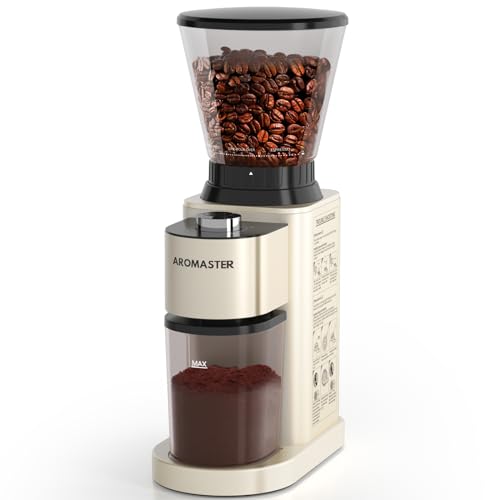
Aromaster Conical Burr Coffee Grinder, 48 Settings, Anti-Static, Beige

KIDISLE Conical Burr Coffee Grinder, 35 Settings, Anti-Static, Black

Tuni G1 Conical Burr Coffee Grinder, 48 Grind Settings, Ivory
More Details On Our Top Picks
This is the only hand-crank option in the lineup, and that distinction shapes everything about ownership. The KINGrinder K6 uses a stainless steel burr set mounted inside an aluminum body, which keeps the unit compact enough for a backpack or a crowded camper drawer. A dual-bearing shaft stabilizes the burr during rotation, reducing wobble that would otherwise produce uneven particle sizes. You turn an external adjustment nut to change grind size, and each click moves the burr by 16 microns, a fine increment that matters most for pour-over and espresso dialing.
Unlike the electric grinders on this list, the K6 asks for physical effort proportional to your dose size. A single cup takes roughly 45 seconds of cranking, which feels meditative on a quiet morning but less appealing when you are rushing out the door. The all-metal construction means no static cling in the catch cup, a real advantage over plastic-bin electrics that scatter grounds across the counter. For anyone who brews away from an outlet or simply enjoys the ritual, the trade-off of manual labor is easy to accept.
Plus Points
- 16-micron click adjustment gives you repeatable precision across pour-over, AeroPress, and espresso ranges without guessing
- Full aluminum body and stainless burr set resist corrosion and survive travel bag abuse that would crack a plastic housing
- Dual-bearing stabilization keeps the inner burr centered, producing noticeably more uniform grounds than single-shaft manuals
- External adjustment nut lets you change settings without disassembling the grinder, unlike internal-dial designs that require removing the burr
- Metal catch cup eliminates static throw, so grounds drop cleanly instead of clinging to the walls
Points To Note
- Hand-cranking enough for a full pot of French press takes sustained effort and several minutes, which may wear thin for daily high-volume use
- The straight handle detaches for storage but can work loose mid-grind if not fully seated before each session
- No grounds container capacity markings, so you weigh beans separately before loading the hopper
Quick Facts
Who Will Love This
Campers, travelers, and pour-over enthusiasts who want repeatable precision without a power cord will find the K6 fits their routine naturally.
Look Elsewhere When
You brew multiple large carafes daily and would benefit from the SHARDOR Conical Burr Espresso Coffee Grinder Electric Precision Timer 2.0, which handles dose volume automatically at the press of a button.
Moving from the manual KINGrinder to this SHARDOR model shifts the experience entirely. A 40 mm stainless steel conical burr driven by an electric motor does the work your arm was doing, and a touchscreen interface replaces the external click-dial. SHARDOR specifies 51 grind settings, which is three more than the Aromaster models also on this list, giving you finer granularity at both ends of the spectrum. The burr geometry aims to minimize frictional heat during grinding, protecting the volatile oils in the bean that carry aroma into your cup.
The precision timer runs up to 60 seconds in 0.1-second increments, meaning you can stop the motor at an exact moment rather than eyeballing the dose. A cup selector scales from 1 to 12 cups, so a household pulling two morning Americanos and an afternoon French press can program each dose without recalculating. Anti-static treatment on the chute reduces the clumping and scattered-grounds problem that plagues cheaper electrics. In a busy kitchen where someone is making toast while the grinder runs, that cleanliness factor matters more than you might expect.
Highlights
- 51 grind settings cover the full espresso-to-French-press range with more intermediate steps than the Aromaster or KIDISLE models offer
- 0.1-second timer precision lets you lock in a dose that repeats every morning without weighing beans separately
- 40 mm stainless steel burr produces uniform particles while limiting heat buildup that would dull flavor
- Anti-static chute keeps grounds flowing into the container instead of clinging to the exit ramp
- Touchscreen controls wipe clean with a damp cloth, unlike physical dials that trap coffee dust in their crevices
Minor Gripes
- The touchscreen can register accidental taps if your fingers are wet or floured, which may shift your setting mid-dose
- Burr removal for deep cleaning requires unscrewing the hopper assembly, which is more involved than the Aromaster’s removable-burr design
Feature Snapshot
Right Fit For
Multi-method households pulling espresso some mornings and French press on others will appreciate the 51-setting range and programmable timer most.
Reach For A Different Pick When
You want a lighter countertop footprint and a warmer aesthetic, in which case the Aromaster Conical Burr Coffee Grinder in Beige offers the same 48-setting range in a softer finish.
The Aromaster in black sits between the feature-heavy SHARDOR and the simpler KIDISLE in terms of scope. You get 48 grind settings, which is three fewer than the SHARDOR but thirteen more than the KIDISLE, placing it squarely in the middle of this lineup’s adjustment range. The bean chamber holds up to 3.9 ounces, enough for a family or a small office without refilling between each pot. A 40-second adjustable timer handles dose control, and the removable burr makes weekly cleaning straightforward.
Aromaster highlights an upgraded anti-static system that keeps grounds from scattering across the counter when you pull the catch container. The tinted bin design reduces ultraviolet exposure to stored beans, a thoughtful touch for anyone who loads the hopper the night before. Operation stays quiet enough for an early-morning kitchen where someone is still sleeping, which is a real advantage over louder budget grinders that announce themselves through thin walls. The included cleaning brush reaches into the burr chamber after you remove the burr, simplifying a maintenance step many owners skip.
Upsides
- 3.9-ounce hopper capacity holds enough beans for a full household’s morning without a mid-week refill cycle
- Removable burr assembly pops out for brushing, unlike fixed-burr designs that force you to clean around the motor shaft
- Tinted catch bin limits UV exposure, preserving bean oils longer when you store beans in the hopper overnight
- Quiet motor operation suits shared living spaces and early mornings where noise would wake others
Trade Offs
- 48 settings is generous but still three fewer than the SHARDOR, so espresso purists chasing the finest possible increment may find the steps slightly coarse
- The 40-second timer ceiling is shorter than the SHARDOR’s 60-second range, which could matter for very large batch grinding
- Black finish shows coffee dust and fingerprints more readily than the beige variant, requiring more frequent wiping to look clean
At A Glance
Best Suited To
Shared kitchens and small offices that value quiet operation and enough capacity to serve several people without refilling between each cup.
A Better Fit Elsewhere
You want maximum adjustment granularity for espresso dialing, where the SHARDOR Conical Burr Espresso Coffee Grinder Electric Precision Timer 2.0 and its 51 settings give you finer control.
Same grinder, different wardrobe. The beige Aromaster carries the identical 48-setting range, 3.9-ounce hopper, 40-second timer, and removable stainless burr as the black version covered above. The difference is purely cosmetic, but cosmetics influence how a countertop feels. A light-tone finish blends into marble, butcher block, or Scandinavian-style kitchens where a black appliance would stand out as a dark block.
Functionally, nothing changes from the black model. The anti-static system performs the same way, the quiet motor runs at the same volume, and the tinted catch bin still reduces UV exposure to stored beans. The one practical shift is that beige hides coffee dust and light fingerprints better than the black finish, so the grinder looks cleaner for longer between wipe-downs. You may find this matters more than expected in a kitchen where the grinder sits out permanently rather than living in a cabinet.
Strong Points
- Beige finish camouflages light coffee dust and fingerprints, requiring less frequent cleaning to look presentable on an open counter
- Identical 48-setting range and removable burr to the black Aromaster, so performance is not compromised by the color change
- Warm tone complements light-countertop kitchens where black appliances would create visual contrast that feels heavy
Small Caveats
- Lighter finish can show dark coffee stains or oil rings more visibly than the black variant if spills are not wiped promptly
- Same 40-second timer ceiling as the black model, which is shorter than the SHARDOR’s 60-second maximum for large-batch grinding
Details At A Glance
Built With In Mind
Shoppers outfitting a light-toned kitchen who want the grinder visible on the counter without a dark appliance disrupting the aesthetic.
Skip It When
You prefer a darker finish that hides coffee stains, in which case the Aromaster Burr Coffee Bean Grinder in Black offers the same performance in a more stain-tolerant color.
The KIDISLE trims the feature count to simplify daily operation. You get 35 grind settings instead of 48 or 51, which still covers espresso through French press but with wider jumps between each step. A cup selector ranges from 2 to 12 cups, matching the SHARDOR’s upper range, and a transparent bean hopper lets you monitor bean levels at a glance. The dial-based control system avoids touchscreen complexity, which some shoppers actually prefer.
Anti-static design on the chute keeps grounds from scattering, matching a feature shared across every electric model in this lineup. The premium burr grinding mechanism aims for consistent particle distribution, though the 35-setting range means you sacrifice fine-tuning headroom compared to the Aromaster or Tuni models. For someone brewing drip coffee most mornings and French press on weekends, that trade-off is barely noticeable. Espresso devotees chasing a specific extraction time may find the wider steps harder to dial in precisely.
Reasons To Buy
- Simple dial control avoids touchscreen misfires and feels intuitive for anyone who prefers mechanical interfaces
- Transparent hopper and grounds container let you monitor levels visually without removing lids to check
- 2-to-12 cup selector handles both single-morning doses and group batches without manual timer programming
- Anti-static chute design keeps the counter clean, matching a feature found on pricier models in this lineup
Softer Spots
- 35 settings is 13 fewer than the Aromaster and 16 fewer than the SHARDOR, so espresso dialing is coarser and less forgiving
- Dial mechanism can accumulate coffee dust around the base over time, requiring periodic brush-out to keep rotation smooth
- Transparent plastic hopper may cloud slightly after months of oil exposure, reducing the visual level-check advantage
Spec Overview
Perfect Match For
Beginners and drip-coffee regulars who want consistent conical burr grinding without paying for espresso-level adjustment granularity.
Consider Something Else When
You pull espresso daily and need finer adjustment steps, where the Tuni G1 Conical Burr Coffee Grinder and its 48-setting range with 0.5-second timer increments gives you tighter control.
The Tuni G1 closes out the lineup with a 48-setting range that matches the Aromaster models but adds a patented anti-static 40 mm conical burr system. The ivory finish sits between the beige Aromaster and a stark white appliance, warm enough for most countertops without drawing the eye. An LED touchscreen handles controls, and the timer adjusts in 0.5-second increments up to 40 seconds, giving you finer dose control than the KIDISLE’s dial approach.
Cup size options span 2 to 12 cups based on Americano serving volume, which means the selector assumes a relatively standard dose per cup. The patented burr design focuses on anti-static performance, and Tuni claims it delivers cleaner grounds transfer than generic anti-static coatings. Compared to the SHARDOR’s 0.1-second timer increments, the Tuni’s 0.5-second steps are coarser, but for most brewing methods that difference is academic. Cold brew and French press, in particular, tolerate half-second dose variation without affecting the cup.
Bright Spots
- Patented 40 mm conical burr system prioritizes anti-static performance for cleaner grounds transfer than generic designs
- LED touchscreen offers intuitive setting selection and wipes clean without trapping dust in physical dial gaps
- 0.5-second timer increments up to 40 seconds provide enough dose precision for espresso, drip, and cold brew routines
- Ivory finish warms up a countertop without the starkness of pure white or the heaviness of black
- 2-to-12 cup selector handles both solo mornings and entertaining without reprogramming the timer manually
Honest Caveats
- 0.5-second timer increments are five times coarser than the SHARDOR’s 0.1-second steps, which may frustrate espresso purists chasing exact dose weights
- LED touchscreen, like the SHARDOR’s, can register stray touches if operated with wet or sticky fingers during a busy morning
Core Details
Whose Shelf It Belongs On
Daily espresso drinkers and cold brew enthusiasts who value a patented anti-static burr system and prefer touchscreen operation over physical dials.
Where A Sibling Pick Shines
You want the finest possible timer control for espresso dosing, where the SHARDOR Conical Burr Espresso Coffee Grinder Electric Precision Timer 2.0 and its 0.1-second increments give you tighter dose precision.
How To Choose The Right Conical Burr Coffee Grinders
Burr Material And Size
Stainless steel burrs, like those on every pick in this lineup, hold an edge longer than ceramic and resist chipping if a stray pebble slips through your beans. The 40 mm burr diameter shared by the SHARDOR and Tuni models strikes a balance between grinding speed and particle uniformity. Smaller burrs grind more slowly but generate less heat, while larger burrs process beans faster but can warm the grounds if you run long batches. For a single cup each morning, either size works well, but households pulling consecutive doses benefit from the thermal stability of a larger burr.
Grind Setting Count And Increment Size
The number of grind settings determines how finely you can tune particle size for each brewing method. Espresso requires the finest settings, French press the coarsest, and methods like pour-over and drip sit in between. The SHARDOR’s 51 settings offer the most intermediate steps, while the KIDISLE’s 35 settings leave wider gaps. Click increment size, like the KINGrinder’s 16 microns per step, matters as much as the total count because it determines how much the grind shifts with each adjustment. Espresso dialing benefits from smaller increments, while French press tolerates coarser steps without affecting the cup.
Dose Control And Timer Precision
Electric grinders handle dosing through either a timer or a cup selector, and the precision of that timer affects repeatability. The SHARDOR’s 0.1-second increments let you lock in an exact dose that repeats every morning. The Tuni’s 0.5-second steps are coarser but still adequate for most methods. Cup selectors, like the 2-to-12 range on the KIDISLE and Tuni, scale the grind time automatically based on a standard serving assumption. Manual grinders like the KINGrinder skip this entirely, leaving dose control to how many beans you load and how long you crank.
Anti-Static Design And Cleanup
Static electricity causes coffee grounds to cling to the grinder chute and scatter across the counter when you remove the catch container. Every electric model on this list includes some form of anti-static treatment, but execution varies. The Tuni’s patented burr system targets this problem specifically, while the Aromaster models use an upgraded anti-static coating. The KINGrinder’s all-metal construction naturally avoids static because metal dissipates charge. Removable burrs, like those on the Aromaster and Tuni, simplify weekly cleaning because you can brush the grinding surfaces directly rather than working around a fixed burr assembly.
A Quick Reality Check
Traps First Timers Fall Into
Shoppers often assume more grind settings automatically means better coffee. In practice, 35 well-spaced settings can outperform 51 poorly spaced ones, and the increment size between steps matters as much as the total count. Another common slip-up is ignoring hopper capacity relative to your household size. A 3.9-ounce chamber suits a family or office, while a manual grinder with no hopper at all works fine for a single-cup mornings. Buying a grinder with a touchscreen because it looks modern, then finding it registers stray taps during a busy morning, is a frustration worth anticipating before you commit.
When Paying More Pays Off
Higher-tier electric grinders justify their cost through burr engineering, timer precision, and anti-static design. A patented burr system like the Tuni’s targets a specific problem, grounds scatter, that cheaper grinders handle with a coating that can wear off. Finer timer increments, like the SHARDOR’s 0.1-second steps, give you dose repeatability that matters most for espresso, where half a gram of grounds can change extraction. The upgrade is worth it for anyone pulling espresso daily or grinding for multiple people, but a pour-over or French press routine may not benefit enough to justify the extra spend.
Closing Remarks
The right conical burr grinder matches your brewing method, counter space, and morning rhythm without adding complexity you do not need. A manual pick like the KINGrinder K6 earns its place for travel and ritual, while the SHARDOR and Tuni models cover electric households that want fine dose control. The Aromaster models balance capacity and quiet operation, and the KIDISLE keeps things simple for beginners. Pick the one that fits how you actually brew, not the one with the most settings on paper.
